

It is a known fact the silk industry has played a significant part in the lives of many nations since the times of Antiquity. This industry has acquired more importance as it reached our day. Silk and spices deriving from the Far East always enjoyed a remarkable role in international relations. Silk has also enabled the west to get acquainted with the East. This was initiated primarily by merchants traveling in both directions.
The Egyptians followed by the Romans, purchased silk from the Chinese and it began to be used by Westerners as early as 753 BC. Studies reveal that it was the monks who first brought cocoons to Byzantium from China in the 6th century AD. The cocoon trade spread from Byzantium to Greece and then to Italy, Spain and France from the 7th Century onward. This is how the Silk Road was born.
The historical silk road
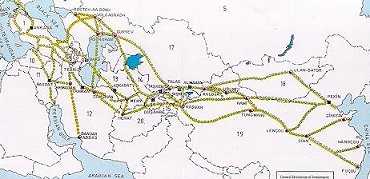 This ancient trade route linking China to the West originated in Xi'an. It was actually a caravan route and played an important part in the exchange of both goods and thought between the two great civilizations of the time, China and Rome. The most important point of convergence of this 6.400 kilometers (4.000 miles) long road was Kashgar.
The caravans of merchants either followed the road leading to the Caspian Sea by passing through the Afghan valleys, or climbed the Karakorum Mountains and arrived in Anatolia via Iran. From Anatolia, the caravans proceeded to Europe either by sea or by the Silk Road that passed through the Thrace Region. During the Mongolian period in the 13th and 14th centuries, Marco Polo traveled on the Silk Road to reach China. Even Today, the Silk Road offers an extraordinary variety of historic and cultural richness. It still bears the marks of cultures, religions and races of 2000 years standing. This majestic trade route spans on two continents. Its vastness, harsh geographical structure and mysteries still bear traces of man's struggle with nature during his long and strenuous journeys.
The Anatolian silk road itinerary
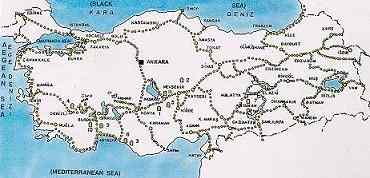 The caravan routes transporting silk, porcellains, paper, spices and precious stones from one continent to the other followed several itineraries in Asia before arriving in Anatolia, which served as a bridge linking it to Europe via the Thrace region. These caravan routes later acquired the name of silk roads and Anatolia constituted the crossroad of these routes. The major cities lying on the Silk Road Anatolia were:
- In the North: Trabzon - Gümüshane - Erzurum - Sivas - Tokat - Amasya - Kastamonu - Adapazari - Izmit - Istanbul - Edirne
- In the South: Mardin - Diyarbakir - Adiyaman - Malatya - Kahramanmaras - Kayseri - Nevsehir - Konya - Isparta - Antalya - Denizli
Another frequently used itinerary is know to be the one through Erzurum - Malatya - Kayseri - Kirsehir - Ankara - Bilecik - Bursa - Iznik - Izmit and Istanbul.
Apart from these land connections, sea routes were also used:
- In the Black Sea the road from the north passed over Batum to Trabzon - Sinop - Istanbul - Bursa - Gallipoli and then reached Venice.
- In the Mediterranean it extended from Syria to Antakya - Antalya - Izmir - Foca and from there to Europe.
When you check todays road map of Turkey you can see very similar trajectories with the old Silk Road routes.
The silk road project
After the Turkic Republics in Central Asia acquired their independence, the idea was raised to revive the Silk Road both as a trade route and as a cultural and historical heir with the aim of restoring the inns and caravanserais to meet present day requirements. The Ministry of Tourism is planning to reactivate the Silk Road on which these unique examples of our cultural heritage still stand. This project aims at creating a contemporary tourism movement by transforming the Silk Road, extending from the Adriatic to the Pacific, into a route of love, peace and brotherhood.
In 1997 a group of explorers walked on the Silk Road trying to imitate ancient caravans with their camels, it took them around 14 months to travel from China to Turkey. Lately many travelers, film makers, documentaries and adventurers are more and more interested on this route, which would make it a popular itinerary once again.