Below you can find some useful information on the Republic of Turkey and a variety of facts and statistics at a glance. For Frequently Asked Questions, you can follow the link.
Flag
 Official flag of the Republic of Turkey is red background with a vertical white crescent (the closed portion is toward the hoist side) and white five-pointed star centered just outside the crescent opening. It's called as "al sancak" in Turkish, meaning "red banner".
Names
Türkiye Cumhuriyeti (Turkish long form) or Türkiye (Turkish short form)
Republic of Turkey (formal English); Turkey (English short form); Turchia (Italian); Türkei (German); Turkiet (Swedish); Turkije (Dutch); Turkki (Finnish); Turquia (Portuguese); Turquía (Spanish); Turquie (French); Tyrkia (Norwegian); Tyrkiet (Danish); Tyrkland (Icelandic)
Important note: As of June 2022, the country name "Türkiye" has replaced "Turkey" at the UN, following an official letter submitted to the United Nations by the government.
Geographic location
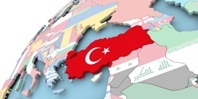 The Geographic location of Turkey is the South-western Asia (that part west of the Bosphorus is sometimes included with Europe), bordering the Black Sea, between Bulgaria and Georgia, and bordering the Aegean Sea and the Mediterranean Sea, between Greece and Syria.
It has a strategic location controlling the Turkish Straits (Bosphorus and Dardanelles) that link the Black sea to the north and the Aegean sea to the west. The Mount Ararat, legendary landing place of Noah's Ark, is in the far eastern portion of the country, in the province of Agri. The country is divided into 7 fictional geographic regions.
Geographic coordinates: 39 00 N, 35 00 E
Area
Total area: 780,580 square kilometers (301,384 square miles)
Land area: 770,760 sq km
Water area: 9,820 sq km
Comparative area: slightly larger than Texas state in USA, or larger than France and UK put together, or 2.5 times larger than Italy.
Land boundaries
Total: 2,648 km
Border countries: Armenia 268 km, Azerbaijan 9 km, Bulgaria 240 km, Georgia 252 km, Greece 206 km, Iran 499 km, Iraq 352 km, Syria 822 km.
Coastline: 7,200 km
Terrain
Terrain: mostly mountains; narrow coastal plain; high central plateau (Anatolia)
Lowest point: Mediterranean Sea 0 meters
Highest point: Mount Ararat 5,166 meters (16,950 feet)
Largest lake: Lake Van 3,713 square km (1,434 sq miles)
Natural resources: coal, iron ore, copper, chromium, antimony, mercury, gold, barite, borate, celestite (strontium), emery, feldspar, limestone, magnesite, marble, perlite, pumice, pyrites (sulfur), clay, arable land, hydropower.
Land use
Arable land: 32%
Permanent crops: 3%
Other: 66% (2006)
Maritime claims
Exclusive economic zone: in Black Sea only - to the maritime boundary agreed upon with the former USSR.
Territorial sea: 6 nautical miles in the Aegean Sea, 12 nm in the Black Sea and in the Mediterranean Sea.
Climate
Climate: temperate; hot, dry summers with mild, wet winters; harsher in interior.
Environment
International agreements: party to - Air Pollution, Antarctic Treaty, Biodiversity, Desertification, Endangered Species, Hazardous Wastes, Ozone Layer Protection, Ship Pollution, Wetlands, Environmental Modification.
Current issues: water pollution from dumping of chemicals and detergents; air pollution, particularly in urban areas; deforestation; concern for oil
spills from Bosphorus ship traffic.
Population
Officially 85,372,377 as of 1st January 2024 (67,803,927 in 2000 & 13,648,270 in 1927); average of 111 inhabitants live per square kilometer, 93% of the total population live in the cities and 7% in villages or small towns in the countryside.
Istanbul: 15,655,924 as of 1st January 2024 (10,033,478 in 2000); 18.34 % of the total population, 3,013 people per square kilometer
Ankara: 5,803,482 as of January 2024 (4,007,860 in 2000); 6.79 % of the total population, 237 people per square kilometer
Izmir: 4,479,525 as of January 2024 (3,387,908 in 2000); 5.24 % of the total population, 373 people per square kilometer
Bayburt has the lowest population in Turkey: 86,047 (as of January 2024)
On top of this there are 5,1 million foreigners living in Turkey, of which 3,6 million are Syrian refugees.
Age structure
Total population: male 42,734,071 (50.1%); female 42,638,306 (49,9%) (as of January 2024)
0-14 years: 21,4% (January 2024)
15-64 years: 68,3% (January 2024)
65 years and over: 10,2% (January 2024)
Median age: total 34 years (male: 33,2 years; female: 34,7 years). More than half of the population is under the median age (as of January 2024)
Population growth rate: 0.11% in 2023 (1.45% in 2010 and 2,11% in 1927)
Birth rate: 17.93 births/1,000 population (2011)
Death rate: 6.3 deaths/1,000 population (2006)
Sex ratio: 1.003 male(s)/female (2022)
at birth: 1.05 male(s)/female
under 15 years: 1.05 male(s)/female
15-64 years: 1.01 male(s)/female
65 years and over: 0.75 male(s)/female
Infant mortality rate: 10 deaths/1,000 live births in 2011 (17,5/1,000 in 2006)
Mother mortality rate at birth: 14 deaths/100,000 live births in 2011 (70/100,000 in 2003)
Life expectancy at birth: (2011)
total population: 75 years (73.2 in 2006)
male: 72 years (71.1 in 2006)
female: 76 years (75.3 in 2006)
Total fertility rate: 2.07 children born/woman in 2012 (2.14 in 2008, 2.18 in 2006)
Nationality
Noun: Turk(s)
Adjective: Turkish
Ethnic divisions: Turkish 80%, Kurdish 20%
Religions: Muslim 99% (mostly Sunni), other 1% (Christian and Jews)
Official Language: Turkish
Literacy: age 6 and over can read and write (2015)
total population: 96,22%
male: 98,71%
female: 93,72%
Governmental overview
Conventional long form: Republic of Turkey
Conventional short form: Turkey
Local long form: Türkiye Cumhuriyeti
Local short form: Türkiye
Data code: TU or TR
Type of government: republican and presidential parliamentary democracy
Capital: Ankara
Administrative divisions
81 provinces (plural "iller" - singular "il"); Adana, Adiyaman, Afyon, Agri, Aksaray, Amasya, Ankara, Antalya, Ardahan, Artvin, Aydin, Balikesir, Bartin, Batman, Bayburt, Bilecik, Bingol, Bitlis, Bolu, Burdur, Bursa, Canakkale, Cankiri, Corum, Denizli, Diyarbakir, Duzce, Edirne, Elazig, Erzincan, Erzurum, Eskisehir, Gaziantep, Giresun, Gumushane, Hakkari, Hatay, Icel, Igdir, Isparta, Istanbul, Izmir, Kahramanmaras, Karabuk, Karaman, Kars, Kastamonu, Kayseri, Kilis, Kirikkale, Kirklareli, Kirsehir, Kocaeli, Konya, Kutahya, Malatya, Manisa, Mardin, Mugla, Mus, Nevsehir, Nigde, Ordu, Osmaniye, Rize, Sakarya, Samsun, Sanliurfa, Siirt, Sinop, Sirnak, Sivas, Tekirdag, Tokat, Trabzon, Tunceli, Usak, Van, Yalova, Yozgat, Zonguldak
Independence
Independence: 29 October 1923 (successor state to the Ottoman Empire)
National holiday: Anniversary of the Declaration of the Republic, 29 October (1923)
Constitution: 7 November 1982 , with various amendments by TBMM
Legal system
Derived from various European legal systems; accepts compulsory International Court of Justice (ICJ) jurisdiction, with reservations. Member of the European Court of Human Rights (ECHR).
Suffrage
18 years of age; universal.
Executive branch
Chief of state
Head of government
Head of government: President Erdogan is elected in June 2018 and Turkey moved into a new Presidential Governing system. Before the amendments of the Constitution, the head of Government was Prime Minister Mr. Binali Yildirim, who was appointed by President Erdogan in May 2016.
National Security Council (MGK)
Advisory body to the President and the cabinet.
Cabinet
Council of Ministers appointed by the President.
Legislative branch
Grand National Assembly of Turkey, abbreviated as TBMM (Turkiye Buyuk Millet Meclisi), is a unicameral parliament with 600 seats. Deputies are elected by public vote to serve five-year terms.
Judicial branch
The judicial system in Turkey has a multipartite structure at the levels of first instance courts, district courts and supreme courts.
Constitutional Court (AYM) where judges appointed by the president and the parliament.
High Court of Appeals (Yargitay) and Council of State (Danistay) where judges are elected by the Supreme Council of Judges and Prosecutors (HSYK).
Court of Accounts (Sayistay)
Military High Court of Appeals
Military High Administrative Court (YAS).
Political pressure groups
Confederation of Public Sector Unions or KESK; Confederation of Revolutionary Workers Unions or DISK; Independent Industrialists' and Businessmen's Association or MUSIAD; Moral Rights Workers Union or Hak-Is; Turkish Industrialists' and Businessmen's Association or TUSIAD; Turkish Confederation of Employers' Unions or TISK; Turkish Confederation of Labor or Turk-Is; Turkish Confederation of Tradesmen and Craftsmen or TESK; Turkish Union of Chambers of Commerce and Commodity Exchanges or TOBB.
International organization participation
AsDB, Australia Group, ASEAN (observer), ASEF, BIS, BLACKSEAFOR, BSEC, CE, CERN (observer), COE, D-8, EAPC, EBRD, EBU, ECAC, ECO, EPO, ETSI, EU (applicant), FAO, FIFA, IAEA, IBRD, ICAO, ICC, ICFTU, ICRM, IDA, IDB, IEA, IFAD, IFC, IFRCS, IHO, ILO, IMF, IMO, Interpol, IOC, IOM (observer), ISO, ITU, NATO, NEA, NSG, OAS (observer), OECD, OIC, OPCW, OSCE, PCA, Turkic Council, UEFA, UN, UNCTAD, UNESCO, UNHCR, UNIDO, UNMIK, UNMIL, UNMISET, UNOMIG, UNRWA, UPU, WCO, WEU (associate), WFTU, WHO, WIPO, WMO, WToO, WTrO, ZC.
Economic overview
Turkey's dynamic economy is a complex mix of modern industry and commerce along with a traditional agriculture sector that in 2019 accounted for 18,3% of employment (25,2% in 2010). It has a strong and rapidly growing private sector, yet the state still plays a major role in basic industry, banking, transport, and communication. Its most important industry and largest exporter is textiles and clothing, which is almost entirely in private hands. The economic situation in recent years has been marked by rapid growth coupled with partial success in implementing structural reform measures. Inflation was declined to the lowest 8,53% in 2016 (then raised again), down from 90% in 1997, but the public sector fiscal deficit probably remained near 10% of GDP due in large part to interest payments which accounted for 40% of central government spending in 2003. The government enacted a new tax law and speeded up privatization in 1998 but made no progress on badly needed social security reform. Ankara is trying to increase trade with other countries in the region yet most of Turkey's trade is still with OECD countries. After the implementation in January 1996 of a Customs Union with the EU, foreign direct investment in the country was recorded $15,9 billion in 2011. Results during recent years improved because of strong financial support from the IMF and tighter fiscal policy. A major political and economic issue over the next decade is whether or not Turkey will become a member of the EU. But further economic and judicial reforms and prospective EU membership are expected to boost Foreign Direct Investment (FDI). Privatization sales in 2015 were about US$ 1,99 billion ($6,27b in 2014, $12,48b in 2013).
GDP
GDP (Total): US$ 822,1 billion in 2013 ($735,8b in 2010, $616,7b in 2009)
GDP purchasing power parity (PPP): US$ 25,129 per person (2017) (was US$ 17,959 in 2010)
GDP growth rate: 4,5% in 2023 (1,8% in 2020, 4% in 2015, 8,9% in 2010, 10.7% in 2006)
GDP per capita: US$ 13.110 in 2023 ($8.599 in 2020, $9.826 in 2017, $10.971 in 2013, $15.079 in 2010, $13.710 in 2009, $5.482 in 2006)
GDP composition by sector:
agriculture: 9.7%
industry: 26.8%
manufacturing: 22.2%
services: 54.3% as of September 2018 (63.5% in 2006)
Consumer prices (inflation rate): 64,77% (end of January 2024). Previous years; 14,60% (2020), 94% (1995), 90% (1997), 75% (1998), 68% (1999), 45% (2000), 90% (2001), 31% (2002), 11% (2004), 7.72% (2005), 5.9% (2007), 6.4% (2010), 10,45% (2011), 6,16% (2012), 4,5% (2015), 16,33% (2018), 11,84% (2019)
Investment (gross fixed): 15.5% of GDP (2004 est.)
Population below poverty line: 28,5% in 2019 (16,9% in 2010, 17,1% in 2009, 20,5% in 2007, 20% in 2005, 18% in 2001)
Household income or consumption by percentage share: 70.7% of GDP (2006)
lowest 20%: 5.6%
highest 20%: 47.6% (2009)
Distribution of family income: 44% (2002)
Labor force: 34,3 million in 2022 (25.6 million in 2010)
Labor force by occupation: (2022)
agriculture 15,8%
services 56,5%
industry 20,3%
construction 6,4%
Note: about 5,5 million Turks work or live abroad as of 2020 (3 million in 2005), mostly in Germany.
Unemployment rate: 9,1% as of January 2024 (plus underemployment of 2,9%) for people 15 years of age and up (11.9% in 2010), 13% for 15-64 years of age, 24,9% for 15-24 years of age
Employment Rate: in 2022 it's 47,5% for people 15 years of age and up (41,3% in 2010)
Budget
Revenues: 1101,1 billion TL, approximately US$ 149 billion (2021 estimate)
Expenditures: 1346,1 billion TL, approximately US$ 182 billion (2021 estimate)
Foreign debt stock: US$ 459 billion in 2022 (US$ 268,7 billion in 2009)
Public debt: 34,1% of GDP in 2014 (42,3% of GDP in 2010, 67.5% of GDP in 2005)
Industries: textiles, food processing, autos, mining (coal, chromate, copper, boron), steel, petroleum, construction, lumber, paper.
Industrial production growth rate: 10,2% (October 2020)
Agriculture
Main products: tobacco, cotton, grain, olives, sugar beets, pulses, citrus, livestock
Illicit drugs: major transit route for Southwest Asian heroin and hashish to Western Europe and the USA via air, land, and sea routes;
government maintains strict controls over areas of legal opium poppy cultivation and output of poppy straw concentrate.
Agricultural land: 380.020 sq km (2017) (391.219 sq km - 50.12% of the land area in 2008)
Forest area: 223.429 sq km (2015) (211.887 sq km - 27% of the land area in 2004)
Electricity
220 Volts / 50 Hertz
Plugs & Sockets: Type C or Type F
Capacity: 92.105 MW (July 2020)
Production: 28,900 million MW/h (July 2020)
Consumption: 20,036 million MW/h (March 2020)
Export: 2,67 billion kW/h (2010)
Imports: 1,88 billion kW/h (2010)
Oil
Production: 19,8 million barrel (2019)
Consumption: 50 million tons (2019) (21,2 million tons in 1991)
Imports: 44,82 million tons (2019), mostly from Iraq, Russia, Kazakhstan (14,19m in 2009)
Proved reserves: 341,6 million bbl (2018)
Natural gas
Production: 483 million cubic meters (2019) (975m m3 in 2008), which is only 1,7% of country's need
Consumption: 45,3 billion m3 in 2019 (37,41b m3 in 2010, 27,34b m3 in 2005)
Exports: 762 million m3 (2019) to Greece
Imports: 45,2 billion m3 (2019), mostly from Russia and Iran, also from Algeria, Azerbaijan and Nigeria.
Proved reserves: 3,36 billion m3 in Turkey / 198,8 trillion m3 in the World (2020)
Current account balance
US$ -109,50 billion in 2022 (US$ -99,86b in 2013, US$ -71,66b in 2010, US$ -43.29b in 2005)
Exports: US$ 254,2 billion in 2022 (US$ 151,80b in 2013, US$ 113,88b in 2010)
Commodities: apparel, foodstuffs, textiles, metal manufactures, transport equipment.
Partners: Germany 13.9%, UK 8.8%, US 7.7%, Italy 7.4%, France 5.8%, Spain 4.2%, Iraq (2004)
Imports: US$ 363,7 billion in 2022 (US$ 251,66b in 2013, US$ 185,54b in 2010)
Commodities: machinery, chemicals, semi-finished goods, fuels, transport equipment.
Partners: Germany 9%, Iraq 7,9%, UK 5,8%, Russia 4.6%, Italy 4.4%, France 4.2%, USA 3.7%, UAE 3,3%, Spain 2,9%, Iran 2,8%, China 2.4% (2013)
Proportion of Imports covered by Exports: 67,1% (2017)
External debt: US$ 435 billion in 2020 (US$ 396,8b in 2014, US$ 247,2b in 2007)
Gold reserves of the Central Bank: 564,8 tonnes of gold as of February 2018 (116 tonnes in 2010)
Foreign exchange reserves of the Central Bank: US$ 41 billion as of November 2020 (US$ 83,43 billion as of 30 November 2011)
Economic aid
Recipient: ODA, $635.8 million (2002)
Note: aid for Gulf war efforts from coalition allies (1991) $4.1 billion; aid pledged for Turkish Defense Fund $2.5 billion; aid for Iraqi war (2003) approx. $8.5 billion; aid for Syrian refugees from EU (2015-2016 est.) 3 billion Euros.
Currency
Turkish Lira - TL or TRL or TRY (formerly New Turkish lira - YTL)
Exchange rates: 17 April 2024
USD 1 = 32,50 TL
Euro 1 = 34,64 TL
As of 01/01/2005, six zeroes are dropped from the old TL by the Law, which made 1.000.000 TL equal to 1 YTL. Both TL and YTL banknotes were in physical circulation for one year in 2005 and the old TL banknotes are withdrawn from circulation as of 1 January 2006. As of 1st of January 2009, "Yeni" (New) is dropped off from the name of the currency and YTL is now called TL (Turkish Lira) again.
Some previous rates: US$ 1 = 1,420,000 (Dec. 2004), 1,670,000 (Jan. 2003), 1,400,000 (Feb. 2002), 538,000 (Jan 2000), 420,000 (Jul 1999), 270,000 (July 1998), 175,000 (October 1997), 60,502.1 (January 1996), 45,845.1 (1995), 29,608.7 (1994), 10,984.6 (1993), 6,872.4 (1992), 4,171.8 (1991)
Fiscal year: calendar year
Transportation
Railways
The State Railways is known as TCDD
Total: 12,803 km (2021). Plans are 25.536 km until 2023 and 27.972 km until 2035
Gauge: 8,717 km standard + 2,274 km electrified (2007)
New high-speed train tracks are built or under construction between major cities; 1,213 km as of 2020
Total passenger capacity: 60 thousand (2009)
Capacity of Freight Wagons: 691,634 tons (2007)
Highways
( Detailed Road Map )
Total: 68,231 km (January 2020)
highways: 3,060 km
state roads: 31,006 km
city roads: 34,165 km
Waterways: about 1,200 km (2003)
Motor vehicles: 23,965,229 (October 2020)
Pipelines: gas 3,177 km; oil 3,562 km (2003)
Ports: Gemlik, Hopa, Iskenderun, Istanbul, Izmir, Izmit, Dilovasi - Yilport, Mersin, Samsun, Trabzon
Merchant marine
Total: 526 ships (1,000 GRT or over) 4,666,895 GRT/7,311,504 DWT
Ships by type: bulk carrier 108, cargo 228, chemical tanker 45, combination ore/oil 1, container 25, liquefied gas 6, passenger 5, passenger/cargo 50, petroleum tanker 33, refrigerated cargo 2, roll on/roll off 22, specialized tanker 1
Foreign-owned: 8 (Cyprus 3, Denmark 2, Greece 1, Italy 1, Switzerland 1)
Registered in other countries: 231 (2005 est.)
Airports
Total: 59 civilian (2020) international and national, plus several military airports
with paved runways over 3,047 m: 15
with paved runways 2,438 to 3,046 m: 32
with paved runways 1,524 to 2,437 m: 19
with paved runways 914 to 1,523 m: 18
with paved runways under 914 m: 4
with unpaved runways over 3,047 m: 1
with unpaved runways 2,438 to 3,046 m: 1
with unpaved runways 1,524 to 2,437 m: 2
with unpaved runways 914 to 1,523 m: 8
with unpaved runways under 914 m: 20 (2005 est.)
Heliports: 65 registered (2015) (42 in 2006), out of which 21 are in Istanbul
Civilian aircrafts: 546 wide body passenger planes in 2019 (162 in 2003)
Total passengers: 208,9 million in 2019 (34,5 million 2003)
Flight destinations: 350 cities abroad, 121 countries in 2019 (60 cities in 2003)
Communication
Country code: +90
Telephones (land lines): 11,009,614 in March 2017 (16,201,466 in 2010, 18,978,223 in 2005)
Telephone system: fair domestic and international systems, area codes
Mobile GSM users: 80,6 million as of September 2018. Three networks: Turkcell, Vodafone (ex-Telsim), Turk Telekom (ex-Avea)
Domestic: trunk microwave radio relay network; limited open-wire network
International: international service is provided by three submarine fiber-optic cables in the Mediterranean and
Black Seas, linking Turkey with Italy, Greece, Israel, Bulgaria, Romania, and Russia; also by 12 Intelsat earth stations, and by 328 mobile satellite terminals in the Inmarsat and Eutelsat systems (2002). Turkey has four communication satellites; Turksat 1B (31.3 degrees East, not operative since 2006) , Turksat 1C (31.3 degrees East), Turksat 2A (42 degrees East), and Turksat 3A (42 degrees East).
Radio broadcast stations: 36 National, 102 Regional, 955 Local, a total of 1,093 (2005)
Radios: 19.4 million (1997 est.)
Television broadcast stations: 24 National, 17 Regional, 218 Local, a total of 259 (2005)
Total TV and Radio stations: 1190 in 2014
Internet country code: .tr
Internet hosts: 16.874.100 in 2009 (355,215 in 2004)
Internet users: 62 million as of 2020 (14,4m in 2010, 2,24m in 2005, 1,62m in 2000)
Defence
Army branches: Turkish Armed Forces (TSK): Land Forces, Naval Forces Command (includes Naval Air and Naval Infantry), Air Force, Coast Guard Command, Gendarmerie (Jandarma)
Manpower availability:
active military personnel on duty: 398,513 (2017): 359,273 soldiers + 39,240 civilian personnel. There are 203 generals/admirals.
reserve personnel: 429,000 (2012)
males age 15-49: 20,754,882 (2012)
males fit for military service: 15 million (2012 est.)
males reach military age (20) annually: 1,370,407 (2012)
Total males/females fit for military in case of a war: 41,247,000 (2012)
Defense expenditures: US$ 22,6 billion (2014), 2.5% of GDP (2011)
Military vehicles: 4,460 tanks, 265 war ships, 16 submarines, 99 military airfields, 874 helicopters, 1,940 military planes, 7,133 armoured vehiles (2013 est.)